Tuesday, 8 February 2011

SUBSIDIARY TASKS: POSTER AND REVIEW

So I have begun my subsidiary tasks - I have decided my layout etc for my two subsidiary tasks.
For my poster, I have decided that it will be like a series of framed photographs hanging on a wall adorned with old fashioned wallpaper. The photos will be both of the boy and the dog together, and alone. I have not yet decided on the title of my film, suggestions welcome.
For my review I have decided it will be quite clean and white, with a shot taken from the film as the photograph. I have decided that it will be quite cool because I don't want to overpower people with bright colours, which are also associated with tubthumpin' action films.

Tuesday, 1 February 2011

INSPIRATION

Okay, to distance myself from the 'cute' image of a film about animals, I have started looking at film drama posters. One thing I have noticed about myself today is that I like poster
s with people's faces in them - which you will see now.
As I chose so many posters that I liked, I am going to post them all, but only talk about a select few (If that's okay with you).

The firs poster I have decided to look at is the poster for 'Little Miss Sunshine', a quirky drama about a dysfunctional family who journey to California so their oddball daughter can compete in a beauty contest. Trust me, it is a barrel of laughs. The picture on the poster is taken from a scene of the film, and I like it because it is humourous, yet doesn't say too much about the plot.

The next film poster I looked at was for 'La Haine', Mathieu Kassovitz's
acclaimed drama about life in the Parisien suburbs during the
riots. If you haven't seen it, I recommend it to you. The poster literally just shows one of the main characters, Vinz's (played by Vincent Cassel) eyes, and the quote "A BRUTALLY BRILLIANT MASTERPIECE" leaves the plot totally open and creates tension for the audience.


The next film poster that inspired me was this one for 'The King's Speech' -
although it is not a poster that I have actually seen before, it definitely made an impact on me. The contrast of the colours used, and again it was not a complete giveaway about the plot - if you hadn't heard about the film, you would get no clues about the plot from the poster, although personally, this poster makes me want to find out about the film.

Also, please excuse the terrible formatting of pictures here!


INSPIRATION

I need some inspiration in my life for ideas for my poster and also for a name for my film. I kind of don't want this to film to be all about the dog, ooh look how pretty it is. No. One titbit of inspiration has been given to me, and it is a poem by Simon Armitage about leaving home.

Mother, any distance greater than a single span
requires a second pair of hands.
You come to help me measure windows, pelmets, doors,
the acres of the walls, the prairies of the floors.

You at the zero-end, me with the spool of tape, recording
length, reporting metres, centimetres back to base, then leaving
up the stairs, the line still feeding out, unreeling
years between us. Anchor. Kite

I space-walk through the empty bedrooms, climb
the ladder to the loft, to breaking point, where something
has to give;
two floors below your fingertips still pinch
the last one-hundredth of an inch... I reach
towards a hatch that opens on an endless sky
to fall or fly.


Pretty nifty, hey?

Tuesday, 25 January 2011

AUDIENCE THEORY


Yet more audience research; I am delving deeper and focusing more on categorising my audience. I have been looking at NRS social grade and the ACORN system. I found it difficult to categorise my audience because dogs seem to break the boundaries (ie lots of people have dogs). Because the breed being used in my film, King Charles Cavaliers are the 6th most popular breed in the UK, and comparatively not that expensive, I decided that on the NRS social grade I would categorise my audience between B, C1 and C2 - which I know is quite broad, but then a large majority of people own dogs. For the ACORN system (which is far, far more specific than the NRS social grade), I decided that the viewers of my film would be somewhere between the categories of Comfortably Off and Moderate Means.

AUDIENCE.


I have decided to look at my audience more closely; I will be examining them (my audience) closely in relation to these things called the 'effects models':
The hypodermic needle model:
The intended message is directly received and wholly accepted by the receiver.

Two step flow:
The people with most access to media, and highest media literacy explain and diffuse the content to others. This is a modern version of the hypodermic needle model.

Uses and gratifications:
People are not helpless victims of mass media, but use the media to get specific gratifications.

Reception theory:
The meaning of a "text" is not inherent within the text itself, but the audience must elicit meaning based on their individual cultural background and life experiences.

Obstinate audience theory:
This theory assumes that there is a transactional communication between the audience and the media. The audience actively selects what messages to pay attention to.

Having looked at the above theories, I believe that the audience of my film will comply with the hypodermic needle model; because I wish to show it after Come Dine With Me (the housewives' mainstay), I imagine that people just keep on watching (ie ambushing them into watching my film).

Tuesday, 18 January 2011

WHERE WILL MY SHORT FILM REVIEW GO?

I have recently been thinking about what magazine would feature my short film. Personally, I don't think my film would be at home in film magazine Empire, so I put the feelers out, focusing on local magazines.
One magazine that caught my eye is Outline - Norwich's free monthly magazine that focuses on both local, national and international artists and acts which is distributed at local centres like The Arts Centre and The UEA. Its target audience is quite broad, considered to be people aged 18-35, who visits these centres of culture (ooh la la). In Outline, they have a feature called 'Art & About', which is about local arts stuff, exhibitions, etc, and this could be a good section for a feature on upcoming short films and makers.

AUDIO POSSIBILITIES.

After furious searching for music to go with my short film, I have found various pieces that I believe could be a good fit for it.

Below is Beethoven's Piano Sonata Number 1 - I think the subtlety of the piece would be good for my film as it is quite low key.

MUSIC

This afternoon I have been focusing my attentions on the soundtrack to my short film. I am not sure if you are familiar to the film soundtrack of the movie "Up", but the original score, written by Michael Giacchino (which won an Academy Award for best original score, I'll have you know) , is the kind of thing I am looking for. Because the music for my short film, if using more than 30 seconds of it, has to copyright free, I have been trawling the free music sight freeplaymusic.com for music of a similar style.
Having done my musical research, I found that Giacchino uses a technique in his music called 'thematic transformation', which is where more than one theme is involved and related together in one piece of music.
This is the kind of thing I will be looking to include in my short film - taking musical inspiration from one of the earlier scenes in the film, w
here the story of this couple's life is told - the music is continuous throughout, yet changes from happy to sad as their life goes through up and down periods. I hope to have one continuous piece of music throughout my short film, with the musical piece changing as the mood changes.
Having learnt that famous composers Ludwig van Beethoven and Franz Liszt also used the technique of thematic transformation, and knowing that music over 50 years old is copyright free (and these musicians were alive and kicking in the 1800s), I have been delving deep into their works.

Tuesday, 11 January 2011

MY NEW INSPIRATION

I found myself getting rather bored with my idea - it needed more structure. So I have decided to introduce a newer second storyline. This new storyline will tell the story of the older sibling moving away for university, with the death of his dog symbolising the death of his childhood. Therefore, I have decided to change the running order of events for my short film. Here is my shot list (work in progress):
- Shot 1: Long shot of the dog and boy playing in the garden. Will be a still shot, and I will perhaps use a puppy to symbolise the old dog when he was young, and my younger brother to play the boy when he was a young'un. Implied growing up together.
- Shot 2: Mid shot of grown up boy and old dog sitting together.
- Shot 3: Shot of a calendar with dates marked for when the dog will be put down, and the date for the boy's move to uni.
- Shot 3: Time passing, dog aging, boy packing.
- Shot 4: Dog being spoilt by his owners
- Shot 5: Time carries on passing
- Shot 6: Family leaves with dog in car, car drives away
- Shot 7: Family return to house minus dog (implied death), return with his lead.
- Shot 8: Boy packing, mid shot of boy and family loading up the car. The car leaves.
- Shot 9: Boy's family wave him off.
- Shot 10: Family generally being miserable.
- Shot 11: Mother and father enter this house with new dog.
- Shot 12: Family are happy again.
Bear in mid, this is very vague - hopefully my animatic should help with deciding more definite angles and time in each scene, etc.

Thursday, 6 January 2011

FILMING PROGRESS

I did some filming over the Christmas holidays - and I decided to focus my filming efforts on what would be the 'filler' of my short film. Having little ideas as to what I wanted to happen in the middle, yet knowing what happens in the beginning and the end has been tricky.

Thursday, 9 December 2010

BBFC

The BBFC is the British Board of Film Classification/, who decide what age certificate a film will have. I've decided that my film will either be a PG or a U - because it has no violence, no bad language, although the content may be upsetting.

A 'U' film should be suitable for audiences aged four years or older. 'U' films should be set within a positive moral framework and should offer reassuring counter balances to any violence, threat or horror.


A 'PG' film should not disturb children aged eight or younger. General viewing, though some scenes may be upsetting to those aged four years or younger. Parents are advised to consider whether the content may upset younger or more sensitive children.
I believe my film will be a PG rated film because some of the storyline may be upsetting to younger or more sensitive children.
Although the content of my short film is not explicit or rude or racy or raunchy in any way, I hope it will be viewed by an older and more intelligent audience, than children (no offence), because it is quite a sensitive subject. For those who have a soul.

IDEAS FOR MY SHORT FILM.

Although I have always been certain as to how I wanted the opening and closing shots of my short film to look, I am uncertain about the 'filler', the rest of my short film. I thought maybe in the film I could draw parralels between young and old; for example, my mother once showed me the Godley & Creme music video for 'Cry' (which I will add onto this post), which shows a range of ages crying. I though I could include something like this in the middle of my short film - perhaps even having this multitude of people saying the same thing (i.e. something cheesy like: 'I miss him so much'). However, I don't want the whole film being so... out there, so I also intended to include footage of old dog and man together, new dog and man together, other dogs and other people together ( hopefully old person and old dog together).

DOG BREED.


The dog breed I am going to be using in my film is the Cavalier King Charles Spaniel, which is the sixth most popular dog breed in the UK. By using a popular dog breed, people will be able to identify with it, and will be able to reminisce about their old pets.

AUDIENCE.

I think that the audience for my short film is most likely to be mostly middle aged women - because the product is dealing with the death of animal, as the sad nature of the product may not appeal to young children. Also, the channel I most wanted to distribute my product on, Channel 4's most popular and most watched television show is 'Come Dine With Me' - whose target audience is predominately middle aged housewives. Their total audience is 46.1% these housewives. Therefore, if I was to show my film after or before 'Come Dine With Me', I think I would successfully reach my target audience.

Thursday, 18 November 2010

AUDIENCE RESEARCH.

To start off my research, I decided to have a look at how many people in the UK own pets, and what the most popular pet is today. In some states in America, it is found that people do not 'own' their pet, but they are actually considered to be the pet's guardian - showing that people should care for a pet like they would care for a child.
According to a 2007 survey undertaken by the University of Bristol found that 31% of the population owned dogs, and 26% owned cats, making that 10.5 million dogs, and 10.3 million cats in the UK.

REPRESENTATION.


Again. I apologise, but as I delve deeper and deeper, I discover more and more interesting things. One film I remember is the film 'Cats and Dogs', a film about the 'war' between felines and canines. An interesting thing is that cats are represented as the evil ones, and dogs are seen as good, and win at the end. This shows that an audience would respond more positively to dogs being shown as heroes - I know I certainly wouldn't have gone to see it when I was younger had it been cats prevailing at the end instead of dogs.

POSTERS

Seeing as a poster is my subsidiary task one, I decided to have a look at posters for some films featuring animals and deconstruct them.


The first poster I chose to deconstruct is the poster for Lassie (1994). At the bottom of the poster we see a young boy and Lassie, the fictional collie, running together - of course this connates to the traditional saying of 'man's best friend'. This relates to the tagline of "best friends are forever"; underneath large lettering of Lassie's name in red - the red denotes perhaps love, but also could be a symbol for blood, because often in Lassie films there will be some hideous display of animal cruelty.


The next film poster I chose to deconstruct was 'Cujo', a film about a dog who turns savage after being bitten by a bat. This one is basically self-explanatory - red lettering denotes blood, crazed dog face - big teeth denotes death and grevious bodily harm and what not. I actually find this quite frightening after a time - the more I look at it the more human the eyes seem - perhaps this was deliberate, and distances us from the though of this crazy dog, and makes it seem more human, personifies it.


REPRESENTATION OF DOGS

Whilst I have considered good representation of dogs, I haven't look at BAD representation of dogs. One film I have looked at is 'Cujo', the film adaptation of Stephen King's novel. he gentle St. Benrard, Cujo is bitten by a dog with rabies, and so turns savage and carnage ensues.
Another film I looked at was 'Dog Soldiers', and one point that interested me was that at the start of the film, a soldier was asked to shoot a dog and he refused - this shows people's attitudes towards dogs as good.
One point I did notice about these films was that the dogs bad nature was not self inflicted, they had had something happen to them to make them turn vicious.

DEATH OF ANIMALS IN FILM

Because in my film I will be looking at the death of a beloved pet, I will neeed to look at how the film industry handles the death of animals.


One film that comes to mind when I think about it, is 'Four Lions', Chris Morris' debut film about a bunch of terrorists. During one scene in the film, they are running around with some bombs (sounds terribly grown up, I know), when there is an accident and both a sheep and their friend dies. Although it sounds quite heavy in writing, in the film it is treated as a comic moment - and often death of animals are used for comic effect. Another example of this is the 2003 film ''Just Married' - in one scene, Brittany Murphy's character's boyfriend, played by Ashton Kutcher accidentally kills her dog. I remember watching this film and everyone I was with laughing at this moment, but I personally never found it funny.


However, we are all familiar with the film Bambi - when his mother is killed by the hunters, I don't think that there is a dry eye in the house. In the film Bambi, Disney are not as explicit as the two previous films I have mentioned - although Bambi was made in 1942. A more recent film by Disney dealing with animals is 'Homeward Bound', the tale of 2 dogs and a cat that go cross country in the aim of finding their family. Among the gang is an old dog, named Shadow, who towards the end of the film, injures himself, and is, at the time, presumed dead by his owners. The other animals encourage him to get up to go and greet his owner, yet he insists they go on without him because he is too old. However, eventually he gets up and goes and greets his owners. I think that in was this is very similar to my own ideas for my short film - another aspect that interested me was the fact that the younger puppy in the film voices his desire not to have a permanent home; which relates to unloyalty in puppies, another aspect in my film I'm going to highlight.

Tuesday, 16 November 2010

UPDATE: PLAN/DO/REVIEW


I actually did some filming over the weekend - which was a bit stressful. They say you should never work with children or animals; and I attempted to work with both. I will be reviewing the filming I did for my opening shot - which was one continuous take - on Thursday.
The shot was meant to be: starting in my conservatory, looking out into the garden at the dog owner and the old pet, playing together. PROBLEM 1: the dog would not play, we ran out of biscuits to make him play, and eventually we had to coax him with some cheese and onion crisps. Then I would pick up the camera, and enter into my hallway where we had positioned some beautiful pictures of the old dog, with one frame with some R.I.P. lettering on it (for the less perceptive people out there). PROBLEM 2: the old dog, who the dog owner was playing with in the garden would run through and get in the eyeline of the camera. Then I would walk up the hallway to the front door, where the dog owner would enter with his new dog. PROBLEM 3: timing problems. The dog owner would run from my garden round to the front door, so there would be timing problems and I had to walk very sloooooowly.
But fingers crossed all went well.
On Thursday I will be reviewing my footage, and storyboarding the rest of my film, so I will need a camera and firewire, please.

SHORT FILM DISTRIBUTION


Where are short films shown?
Short films are shown before films at the cinema, which many independent cinemas do, but also Pixar films will often show a short film before the main feature. Another place I have noticed short films being shown is on Channel 4 after the seven o'clock news, a feature which is called the 'Three Minute Wonder'; though these films are often more documentary style films, I think this is a good place to show a short film, as there will be a large amount of viewers.
Another area with a lot of scope for short film is the internet. Both channel 4 and Virgin have competitions to find good short films, and many BBC also has an online archive of short films. Video hosting websites such as Youtube and Vimeo are also good oppurtunities for short films to get views.
I think I would distribute my film either at an independent cinema, or on the Internet. The internet has a larger potential audience than an independent cinema.

Thursday, 21 October 2010

ANIMAL FARM IN FILM.

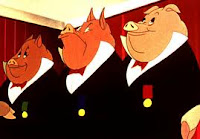
In 1954, an animated film version of Animal Farm was released, directed by Halas and Batchelor, and was actually the first British film to be released worldwide (interesting fact there). This film departs from the original script, yet the characters of the dogs, their personalities and their presence in the film remains the same - they are cruel, and kill other animals on command.
However,in a more recent made for TV (American...) version of Animal
Farm, the story is told from the point of view of a new dog character they invented, called Jessie. It is her puppies who Napoleon trains to be his attack dogs, and in the end they are reunited - therefore the dogs have not turned BAD forever. This truly shows what attachment people have to dogs, for them to invent a new character, for her to be good (which dogs are not in the book or 1954 version), and for her to be the main character - the dogs aren't even really main characters at all!

Thursday, 7 October 2010

REPRESENTATION OF DOGS IN 'OF MICE AND MEN'.


Another book, and film, I looked at was 'Of Mice and Men', which was a book I have previously studied. Quite early on in the book, the character of Candy, who is old and only has one hand (making him kind of useless), allows someone to go out into the woods and kill his dog - something he regrets later on in the book. Candy's dog is described as 'a dragfooted sheepdog, gray of muzzle, and with pale, blind old eyes', and the others don't really like it because it's old and it smells bad, basically. They describe him as 'no good to himself'. It represents Candy's fear that the farm will decide he is no good to them, and fire him, and also foreshadows what George must eventually do to Lennie.
Another important dog in 'Of Mice and Men', is the puppy that Lennie plays with. Originally to be used as a replacement for Candy's dog, who Lennie likes playing with. The puppy represents Lennie's innocence, and his weak, childlike disposition, and his childlike desire to play with nice soft things, his oafish-ness, leads to the death of the puppy, which foreshadows the death of Curley's wife; the accident that seals his fate and ruins his dream.

REPRESENTATION OF DOGS IN ANIMAL FARM.


Because I am using dogs (I like to throw caution to the wind and laugh at those who say 'never work with children or animals') as the main focal point of my short film, I decided to look at how they are represented in books. One book that I have decided to look at is 'Animal Farm' by George Orwell, a story of which I am sure we are all familiar. In 'Animal Farm', the dogs represent the police - they work closely with the main pig, Napoleon. It is thought that the pigs represent Stalin's (a.k.a. the character of Napoleon) secret police, the NKVD, who helped Stalin 'purge' anyone who he thought was a threat to his power. Basically, the NKVD helped Stalin to stay in power as long as possible.
The dogs in Orwell's police represent security, and also fear - Napoleon uses them to kill many other animals, so they are not shown in a very good light. However, the dogs often wag his tail when they see Napoleon; and whilst people suggest that this alludes to him becoming more and more like the farmer they overthrew, it could represent loyalty.

MORE TEXTUAL ANALYSIS.

'If Jesus were alive, yeah, he'd probably be a singer.'
Another short film that has inspired me is 'About a Girl', a 2001 short film directed by Brian Percival and written by Julie Rutterford. It depicts the life of a girl who dreams of being a singer, and admires Britney Spears, and we see her singing many of her songs throughout its entirety, yet her flippant personality is a stark contrast from the feeling of unease we get as the film goes on.
watch the film here:
http://www.bbc.co.uk/filmnetwork/films/p0055x2k

TEXTUAL ANALYSIS


I have been looking at some short films, and stumbled upon a DVD collection of short films called 'Real Shorts'. Two films especially caught my eye. The first; 'I Expect Joan Feels the Same', a poignant film about two elderly women whose husbands were killed in the war. Directed by Sophie Williams, it shows an interview with the two women recalling their wartime loves intercut with archive footage from the war.
Another film that caught my eye was 'Silence', a film directed by Orly Yadin and Slyvie Bringas, features Holocaust survivor, Tana Ross, telling her story of her childhood in a concentration camp, and her teenage years after. Overlayed with different animation styles, it is a very engaging and interesting tale of what caused her 50 year silence of her suffering.

Thursday, 30 September 2010

Print Specification Criteria

I also found the specification marking criteria for the Print tasks, as I have chosen a poster for the film, and a film magazine review of my short film as my subisidiary tasks. Here's that specification criteria:

Level 3

The candidate is expected to demonstrate proficiency in the creative use of most of the following technical skills:
  • holding a shot steady, where appropriate;
  • framing a shot, including and excluding elements as appropriate;
  • using a variety of shot distances as appropriate;
  • shooting material appropriate to the task set;
  • selecting mise-en-scène including colour, figure, lighting, objects and setting;
  • editing so that meaning is apparent to the viewer;
  • using varied shot transitions, captions and other effects selectively and appropriately for the task set;
  • using sound with images and editing appropriately for the task set.

    Where a candidate has worked in a group, a proficient contribution to construction is evident.

Level 4

The candidate is expected to demonstrate excellence in the creative use of most of the following technical skills:
  • holding a shot steady, where appropriate; framing a shot, including and excluding elements as appropriate;
  • using a variety of shot distances as appropriate;
  • shooting material appropriate to the task set;
  • selecting mise-en-scène including colour, figure, lighting, objects and setting;
  • editing so that meaning is apparent to the viewer;
  • using varied shot transitions, captions and other effects selectively and appropriately;
  • using sound with images and editing appropriately for the task.

    Where a candidate has worked in a group, an excellent contribution to construction is evident.

Film/Television/Video Specification Criteria

I have been looking at the OCR assessment criteria, and found the loose marking criteria for the film/television/video tasks. I am aiming for level 3/4 grades, so have decided to only look at them.


Level 3

The candidate is expected to demonstrate proficiency in the creative use of most of the following technical skills:

• holding a shot steady, where appropriate;
• framing a shot, including and excluding elements as appropriate;
• using a variety of shot distances as appropriate;
• shooting material appropriate to the task set;
• selecting mise-en-scène including colour, figure, lighting, objects and setting;
• editing so that meaning is apparent to the viewer;
• using varied shot transitions, captions and other effects selectively and appropriately for the task set;
• using sound with images and editing appropriately for the task set.

Where a candidate has worked in a group, a proficient contribution to construction is evident.

Level 4

The candidate is expected to demonstrate excellence in the creative use of most of the following technical skills:
• holding a shot steady, where appropriate;
• framing a shot, including and excluding elements as appropriate;
• using a variety of shot distances as appropriate;
• shooting material appropriate to the task set;
• selecting mise-en-scène including colour, figure, lighting, objects and setting;
• editing so that meaning is apparent to the viewer;
• using varied shot transitions, captions and other effects selectively and appropriately;
• using sound with images and editing appropriately for the task.

Where a candidate has worked in a group, an excellent contribution to construction is evident.

Short Film Inspiration.

I created a prezi, evaluating short film connoations, and the connotations for my subsidiary task.
Here is the prezi:

Wednesday, 29 September 2010

MY INITIAL IDEAS.

My initial idea for my product, a short film, is dealing with the death of a beloved pet. It will tell the story of the death of an old dog, and then moving on and getting a new one. My ideas for how it will be shot is that, at the start of my film, we see a line up of pictures of the old dog, and then it will stop on a picture of said old dog waiting for his ball to be thrown, in some kind of R.I.P. picture frame - the owner gets a new pet, battles with training it, etc. The film will end with the new dog sitting in the same pose as the old dog. Aww.